Filling Gaps, Funding Transitions, Pioneering the Future: A Life-Cycle Lens for Effective Systems Change
Stay Connected
Get the fifth lens on the work that’s changing communities. Our take on what actually moves the work forward.
Making Systems Work
Every funder we talk to right now is running the same math. Federal dollars that used to anchor a program budget are gone or in question. Application volume to fill that gap has spiked. Grantees are asking for more flexibility while boards are asking for more certainty. And underneath all of it sits a quieter question: are we just trying to keep the old thing alive, or are we actually building what comes next?
That question is worth sitting with, because the two answers require different strategies. Patching a declining system and stewarding an emerging one are both important, but they’re not the same job. Even when they’re happening in the same budget cycle. Systems science frameworks give us a useful way to tell them apart; they widen our view, allowing us to see where we sit in the large cycle of decline and renewal.
Two loops, one moment
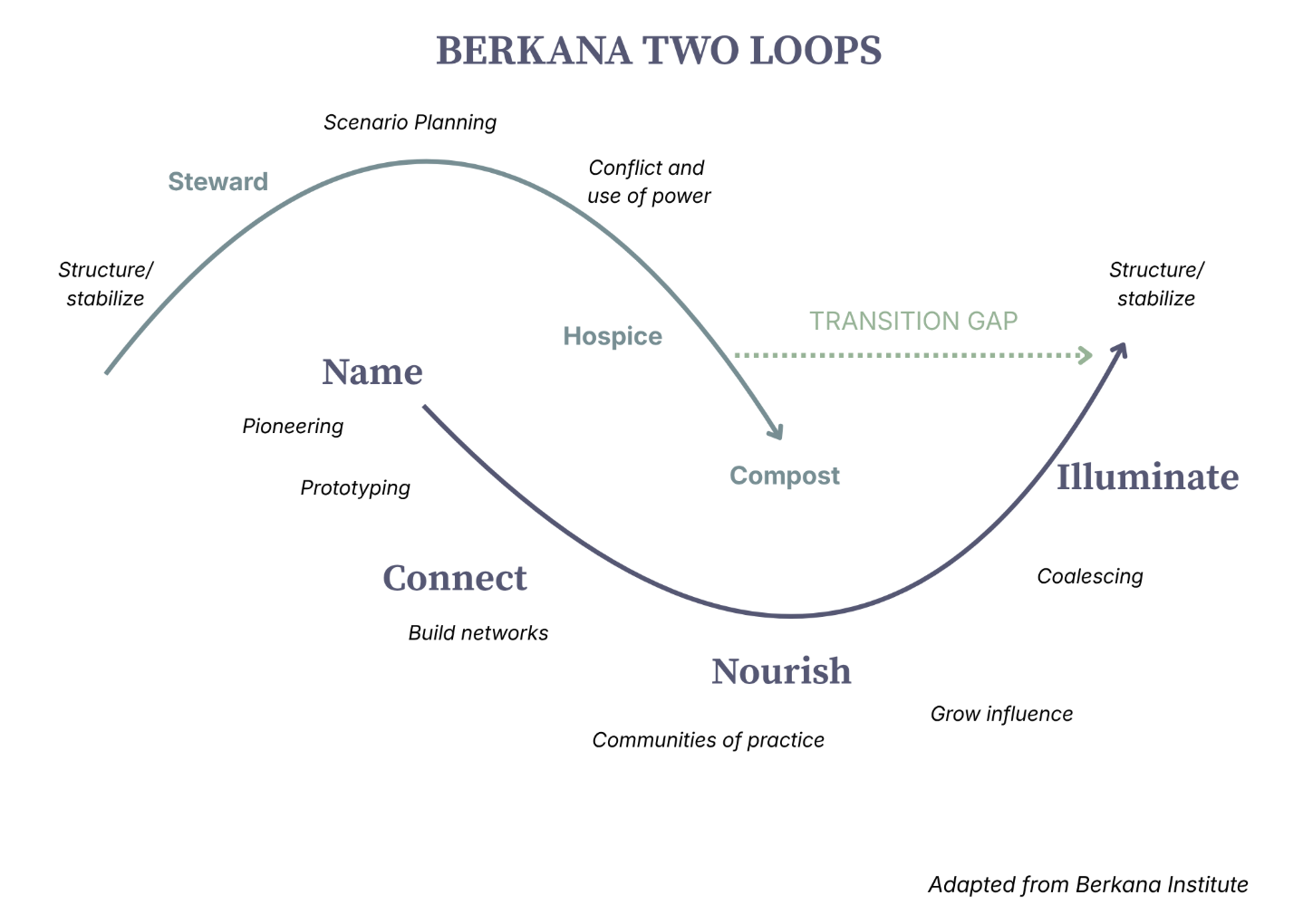
The first is the Two Loops model, developed by the Berkana Institute to describe how systems change over time. A dominant system rises, matures, and eventually begins to decline. As it declines, something else is forming: an emergent system, built by people who are naming what isn’t working, pioneering new practices before they’re fully proven, and connecting into networks. The most important insight in the model isn’t the decline itself. It’s that the emergent system is being shaped, in real time, by whoever shows up to steward it and by what gets deliberately applied from the old system on the way down. That “composting,” carrying forward what’s worth keeping, is active, intentional work. It doesn’t happen by accident.
The second framework is a classic systems archetype: Repression and Revolution. It describes a reinforcing loop between an established structure and an opposition to it. As the opposition grows, the established structure perceives more threat and responds with more control. That control, in turn, legitimizes the opposition and often grows its ranks. Historically, this archetype has been used to describe a fight to preserve a status quo against a challenger.
What’s different about this moment is that the fight looks less like defending an old system against a new one, and more like an open contest over what the emergent system will actually look like. That distinction matters enormously for how funders and mission-driven organizations should be spending their attention. If the emergent system is still being negotiated, then power in this transition is more distributed than the classic framework assumes, and organizations willing to build coordinated networks now have real influence over what gets composted and what gets nourished into being.

Why this matters more than another funding strategy memo
Most of the current advice circulating in the sector is tactical: diversify revenue, tighten compliance, pursue earned income, build cash reserves. All of that is necessary, yet none of it answers the harder question underneath the tactics, which is where an organization or a fund should be placing its energy: helping a declining system sunset well, or building capacity in the one that’s forming?
The distinction is worth the discomfort of naming it. Organizations that spend this entire period trying to make an old funding model work again will, at best, buy themselves time. Organizations and funders who treat this as a genuine system transition and act accordingly are positioned to shape what the field looks like on the other side. That’s a meaningfully different allocation of scarce time and money, and it produces different outcomes.
Putting the framework to work
A few ways this can translate into real decisions:
Name what you’re actually doing before you fund or plan around it. Is this dollar or this initiative propping up a structure that’s declining regardless, or is it nourishing something that’s still forming? Both can be legitimate uses of resources. They are not the same use, and conflating them leads to strategies that satisfy neither goal.
Treat composting as a deliberate design step, not an afterthought. Before an organization or collaborative moves on from a program, structure, or partnership, name explicitly what’s worth carrying forward: relationships, data, trust, institutional memory, community relationships built over years. That’s the material the next system gets built from and it rarely survives a transition unless someone protects it on purpose.
Invest in the connective tissue between organizations, not just the organizations themselves. Networks and coalitions are what move an emergent system from scattered experiments to coordinated momentum. Funders in particular are well positioned to resource the backbone work, facilitation, shared infrastructure, and cross-sector convening that individual grantees rarely have the capacity to carry out on their own.
Give leaders permission to hold both loops at once. The hospice work of bandaging the dying system matters. It keeps people served, keeps the lights on, and buys the time everything else depends on. And yet also, hospice is one role in a larger transition. The organizations and funders who see profound impact in five years are the ones who name that role honestly and understand how it relates to and serves the emergent system. Don’t discount standing in the gap, and stay clear-eyed about how it serves what’s coming next (instead of standing in for or unintentionally hampering it).
Where funders sit in this
Foundations are in an unusual position in this transition. Grantees are, understandably, focused on survival. Funders have more room to ask the bigger question: what does the field need to look like structurally in three years, and what are we doing right now to help build that, rather than just extend the old one? That’s a harder conversation than a grant cycle typically makes room for, but it’s the one that determines whether philanthropic dollars are endlessly filling a growing gap or building a foundation.
This is a moment that rewards organizations and funders willing to look past the immediate budget question and ask a systems-level one instead. The tools for doing that already exist; the most efficient, impactful work is in using them.
